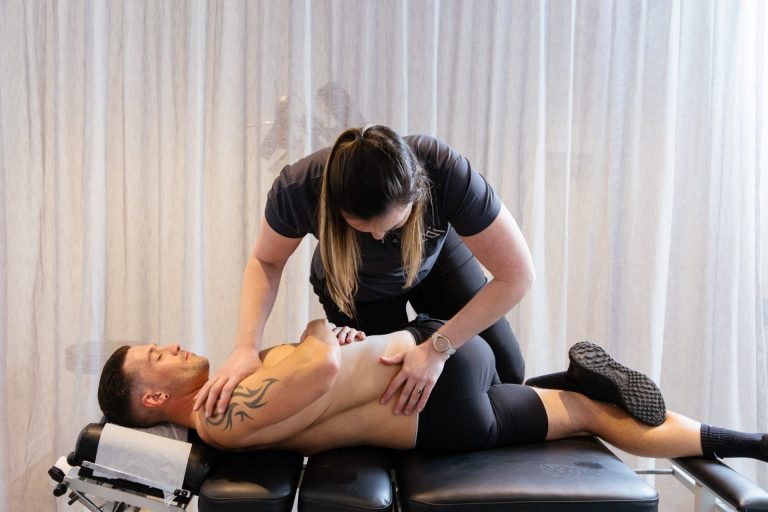
Chiropractic Care for Kids and Teens: Choosing a Chiropractor for Children
Parents call clinics about chiropractic care for children and mostly get marketing back. Here’s what actually matters: what the regulator requires, what changes for a six-year-old versus a sixteen-year-old, and what we refuse to claim.
Is it safe? What the regulator says
Chiropractors in Australia aren’t self-regulated. Anyone who puts hands on your child’s spine is registered through AHPRA and accountable to the Chiropractic Board of Australia.
The Board’s Statement on paediatric care draws a line between children and adults. Children differ from adults in ways that matter. Anatomy, physiology and development all diverge, so the Board expects technique and force modified to suit a patient’s age and the plan discussed with the child and parent before anything begins. It also says plainly that serious adverse events from manual therapy are very rare, but that they can occur.
That last sentence is the one most clinics leave out.
One boundary matters before you book. Since June 2024, the Board’s interim policy advises chiropractors not to use spinal manipulation on children under two years of age while a revised position is settled with Australia’s health ministers. If a practice offers to adjust a newborn, ask how they square that with the policy.
What we do differently with a young spine
In most paediatric cases, the treatment looks nothing like the manipulation people picture. Gentle mobilisation, soft tissue work, exercise and load advice carry the session. High-velocity thrusts are rarely appropriate on a spine that hasn’t finished forming.
Consent runs differently here too. We explain the plan to the child in words they’ll understand, then ask them to agree to it. A six-year-old gets a simple version, a fifteen-year-old gets the real one, and at that age their agreement matters as much as their parent’s.
Sessions are shorter. A first appointment for a child usually runs about 30 minutes, and follow-ups sit closer to 15 or 20.
Finding a chiropractor for children gets easier once you know which questions matter.
We’d rather see a child four times and discharge them than book them into a maintenance plan.
What we treat, and what we do not
Here’s the part that gets left off too many clinic websites. Paediatric chiropractic is musculoskeletal care, and for children and teenagers that means mechanical neck and back pain, postural strain, stiff joints and some sports-related joint pain.
It does not mean asthma, ear infections, colic, bedwetting, ADHD or autism. Those claims aren’t supported by good evidence, and the Board’s advertising guidance is explicit that there is insufficient acceptable evidence for a link between spinal manipulation and the treatment of organic diseases and infections. No child should be brought to a chiropractor for any of those reasons, and if you ring us about one we’ll say so on the phone rather than book you in.
| What we treat | What we refer on |
|---|---|
| Mechanical low back pain and neck pain with no red flags | Spinal pain with fever, night pain or weight loss (GP, same day) |
| Postural strain and posture-related muscular aches | Suspected fracture, stress injury or growth plate damage (sports doctor or physiotherapist) |
| Muscular tightness around a growth spurt | A limp, or hip and knee pain that isn’t settling (GP) |
| Sports injury to joints and muscles once fracture is excluded | Headache with neurological symptoms, or pain after a head knock (GP) |
| Post-injury stiffness once cleared for movement | A spinal curve that’s progressing quickly (GP, paediatric referral) |
| Teenagers training through a flare-up | Babies under two (spinal manipulation isn’t used at that age) |
The teenage athlete problem
Between roughly 11 and 16, a teenager’s bones can lengthen faster than the muscles and tendons attached to them can keep pace with. Add three training sessions a week on top of school sport, and you have a body being asked for more than it can currently give.
Low back pain in adolescents is usually a load problem rather than a bad back. In sports built on repeated extension and rotation, fast bowling and diving chief among them, a stress injury of the pars interarticularis becomes a real possibility. It needs proper assessment, not a handful of adjustments and a hopeful shrug.
The pattern we see most often is a growing athlete whose training load has outrun their tissue tolerance, which parents often describe to us as growing pains. Managing a sports injury at that age means honest conversations about load, a written plan for the next six weeks, and co-management with our physiotherapy and exercise physiology teams.
Talent doesn’t suspend growth plates.
Red flags that need a GP first
Nothing here belongs in a chiropractic room before it’s medically assessed. Book a GP, and go to an emergency department if symptoms came on suddenly or are severe.
- Back or neck pain that wakes your child at night, or worsens with rest
- Fever, unexplained weight loss or feeling generally unwell alongside spinal pain
- Numbness, tingling, weakness or heaviness in the legs, or a change in walking
- Any change in bladder or bowel control, or numbness around the groin (treat that as an emergency)
- Pain after a fall, collision or tackle, especially if severe or one-sided
- A limp, or hip, knee or ankle pain that hasn’t settled in a week or two
- Pain no better after four to six weeks of rest and load changes
- A spinal curve that seems to be moving quickly through a growth spurt
- Headaches with vomiting, visual changes or morning worsening
Questions worth asking any chiropractor for children before you book
healthdirect tells patients to ask about evidence, risks and the number of sessions expected. Those questions work here too.
- Which practitioner is registered with AHPRA to treat my child, and what paediatric training have they completed?
- What’s the evidence for this treatment, and what happens if we do nothing for four weeks instead?
- How many visits are you expecting, and what does improvement look like by visit four?
- Do you write to our GP, and will you tell us when someone else should be managing this?
References
- Chiropractic Board of Australia: Statement on paediatric care (2023)
- Chiropractic Board of Australia: interim policy for children under two (2024)
- healthdirect: Chiropractors and chiropractic treatment
If you want a straight answer about whether chiropractic care suits your child, call Peak Performance Institute in West Leederville on (08) 9381 1265. We’re at 144 Cambridge St, open from 6:30am on weekdays and Saturday mornings, and we’ll happily tell you when your child needs someone else. We mean that.