An ingrown toenail can turn walking into misery. That sharp, throbbing pain at the edge of your toe — often accompanied by redness, swelling, and sometimes infection — is one of the most common problems podiatrists treat. And if you’ve had one, you know: they tend to come back.
At Peak Performance Institute in West Leederville, our podiatry team treats ingrown toenails every day — from simple conservative care to minor surgical procedures that permanently fix the problem. Understanding which type you have, what caused it, and which treatment makes sense for you is the first step to getting your feet back to normal.
The Three Types of Ingrown Toenails
Not all ingrown nails are the same. Your podiatrist classifies them to determine the right approach:
1. Lateral Ingrown (Most Common)
The nail edge grows into the skin fold on one or both sides of the toe. The big toe is affected in over 90% of cases. This is what most people picture when they think of an ingrown toenail — the classic spike of nail piercing the sulcus, often with a bead of granulation tissue (proud flesh) forming as the body tries to heal the wound. Without treatment, the nail continues to penetrate deeper with each step, and secondary bacterial infection is common.
2. Distal Ingrown
The nail curves downward at the tip and digs into the flesh at the end of the toe. Less common than lateral ingrowns but particularly painful — direct pressure from shoes or walking compresses the nail tip into the soft tissue. Often seen in people who wear tight or tapered footwear that forces the toes together.
3. Involuted (Curved) Nails
The entire nail plate has an exaggerated curvature — like a C-shape in cross-section. Both sides of the nail press into the nail folds simultaneously. This type is often hereditary; if your parents had curved nails, you probably do too. Involuted nails may not be acutely infected but cause chronic, low-grade discomfort and are prone to becoming acutely ingrown after minor trauma or poor trimming.

What Causes Ingrown Toenails?
The root causes fall into a few clear categories:
- Incorrect nail cutting — Curving the cut to follow the toe shape (instead of cutting straight across) leaves a spike at the corner that grows into the skin.
- Genetics — Inherited nail shape, particularly wide or highly curved nail plates, predisposes you regardless of how carefully you trim.
- Footwear — Tight shoes, narrow toe boxes, and high heels compress the toes and force the nail into the surrounding skin.
- Trauma — A single event (dropping something on your toe) or repetitive microtrauma (running, soccer, ballet) can alter nail growth direction.
- Biomechanics — Overpronation (excessive inward foot roll) increases pressure on the medial side of the big toe during push-off, contributing to medial ingrown nails.
- Hyperhidrosis — Excessively sweaty feet soften the skin around the nail, making penetration easier.
Understanding the cause matters — because fixing the nail without addressing the driver (e.g., footwear or biomechanics) sets you up for recurrence.
Treatment Option 1: Conservative (Non-Surgical) Care
For mild-to-moderate ingrown nails without significant infection, conservative treatment is often successful:
- Professional nail trimming — Your podiatrist uses specialised instruments to painlessly trim the ingrown spike and smooth the edge. This is not the same as a DIY attempt with bathroom scissors — the right tools and technique make all the difference.
- Nail packing — A small wick of cotton or foam is placed under the ingrown edge to lift it away from the skin as the nail grows. Combined with regular podiatry visits, this can resolve the acute episode.
- Callus removal — Hard skin around the nail fold is debrided to reduce pressure on the affected area.
- Antibiotics — If infection is present, topical or oral antibiotics may be prescribed. However, antibiotics alone won’t fix the mechanical problem — the nail spike must be addressed.
- Footwear advice — Wider toe-box shoes, proper sizing, and avoiding pressure on the affected toe are essential for healing.
Conservative care works well for first-time or mild ingrown nails. For recurring cases — particularly if you’ve had the same toe treated multiple times — a definitive solution is usually better.
Treatment Option 2: Onyfix Nail Correction (Non-Surgical, No Pain)
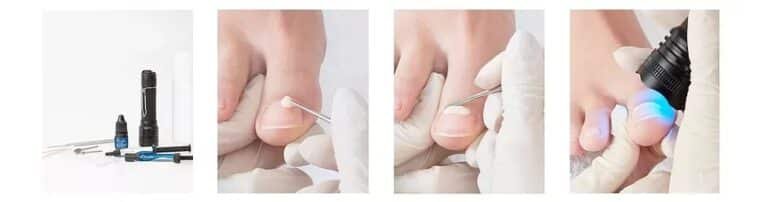
For involuted or curved nails that haven’t yet required surgery, Onyfix offers a genuinely pain-free alternative. A composite resin band is applied across the nail, cured under LED light, and as the nail grows over 2–3 months, the band guides it back to a flatter, healthier shape. No wires, no hooks, no surgery — and you can wear nail polish over the top. Read our full Onyfix guide here.
Treatment Option 3: Partial Nail Avulsion (PNA) Surgery
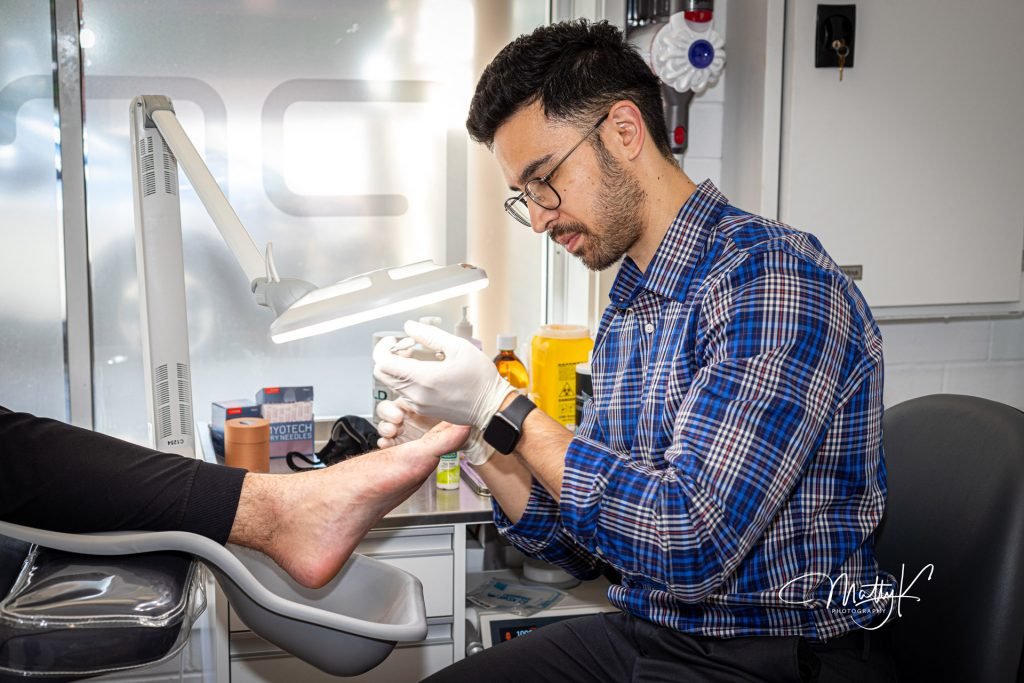
When the ingrown portion is recurrent, infected, or causing significant pain, a partial nail avulsion (PNA) provides a permanent solution. This is a minor surgical procedure performed in the treatment chair — no hospital visit required.
The procedure:
- Local anaesthetic — Two small injections numb the toe. This is the only part of the procedure you’ll feel, and it’s brief.
- Nail removal — The ingrown portion of the nail (usually 2–4 mm from the edge) is removed along with the corresponding section of nail matrix (the growth centre).
- Chemical matrixectomy — Phenol (a mild acid) is applied to the exposed nail matrix to prevent that portion of the nail from regrowing. This is what makes the solution permanent.
- Dressing — A simple dressing is applied, and you walk out. Total procedure time: 30–45 minutes.
Recovery:
- Keep the dressing dry for 24–48 hours
- Mild discomfort managed with paracetamol — most people don’t need anything stronger
- Return to work/school next day (for sedentary roles). Manual work may require 2–3 days
- Return to sport: typically 2 weeks, once the nail bed has healed
- Full healing: the surgical site is fully epithelialised (healed) within 4–6 weeks
The nail appears slightly narrower afterwards — most people don’t notice the difference. The remaining nail grows normally and is not affected by the procedure.
Treatment Option 4: Total Nail Avulsion (TNA)
When the entire nail is thick, damaged, chronically infected, or repeatedly problematic, removing the complete nail plate can be the most effective option. This is less common than PNA but appropriate for:
- Severely thickened, dystrophic nails that resist conservative treatment
- Chronic fungal nails where the nail itself is structurally compromised
- Recurrent ingrown nails affecting both sides simultaneously
- Patient preference — some people simply want the nail gone permanently
The procedure mirrors PNA — local anaesthetic, complete nail removal, phenol to the entire matrix. The toe heals without a nail, and most people find it completely comfortable once healed. Cosmetic options (such as KeryFlex nail restoration) are available if you prefer the appearance of a nail.
Treatment Comparison: Which Is Right for You?
| Treatment | Best For | Pain | Downtime | Permanence | Cost |
|---|---|---|---|---|---|
| Conservative trim | First-time, mild ingrown | None | None | Temporary — may recur | Standard consult |
| Onyfix | Curved/involuted nails, flat nail base | None | None | Long-term — reshapes nail growth | $95-150 per application |
| PNA (Partial) | Recurrent ingrown, single-side involvement | Anaesthetic pinch only | 1–3 days | Permanent for that portion | Consult + procedure fee |
| TNA (Total) | Severely damaged nail, both sides affected | Anaesthetic pinch only | 1–3 days | Permanent — no nail regrows | Consult + procedure fee |
Why You Shouldn’t Ignore an Ingrown Toenail
An untreated ingrown nail doesn’t just hurt — it can lead to:
- Infection — The open wound is a portal for bacteria. Paronychia (nail fold infection) can progress to cellulitis or, in severe cases, osteomyelitis (bone infection).
- Granulation tissue — The body’s attempt to heal the chronic wound produces “proud flesh” that bleeds easily and makes the nail even harder to access.
- Nail deformity — Chronic pressure and inflammation can permanently alter nail growth, making the problem self-perpetuating.
- Diabetic complications — For people with diabetes, an ingrown toenail is a serious matter. Reduced sensation and circulation mean a small wound can become a major problem requiring urgent podiatric attention.
What to Expect at Your PPI Appointment
Your consultation with our podiatrist includes:
- Assessment — We examine the nail, assess for infection, determine the type and severity, and identify contributing factors (footwear, biomechanics, cutting technique).
- Treatment discussion — You’ll be given a clear recommendation — conservative care, Onyfix, PNA, or TNA — with the rationale explained. There’s no pressure toward surgery; the right option is the one that matches your situation.
- Same-day treatment — In most cases, treatment can be performed in the same appointment, whether that’s conservative trimming or a surgical procedure.
- Follow-up — For surgical cases, a review appointment is scheduled at 1–2 weeks to check healing and re-dress the site.
Don’t spend another week limping. Book your ingrown toenail consultation today — call (08) 9381 1265 or visit us at ppiperth.com.au. Located at 144 Cambridge Street, West Leederville, serving patients from Subiaco, Wembley, Leederville, Highgate, and across Perth.
References
- Heidelbaugh, J. J., & Lee, H. (2009). Management of the ingrown toenail. American Family Physician, 79(4), 303-308.
- Rounding, C., & Bloomfield, S. (2005). Surgical treatments for ingrowing toenails. Cochrane Database of Systematic Reviews, (2), CD001541.
- Erdogan, F. G., & Erdogan, G. (2019). A new therapeutic approach to ingrown toenails: Onyfix composite nail correction system. Dermatologic Therapy, 32(4), e12942.