
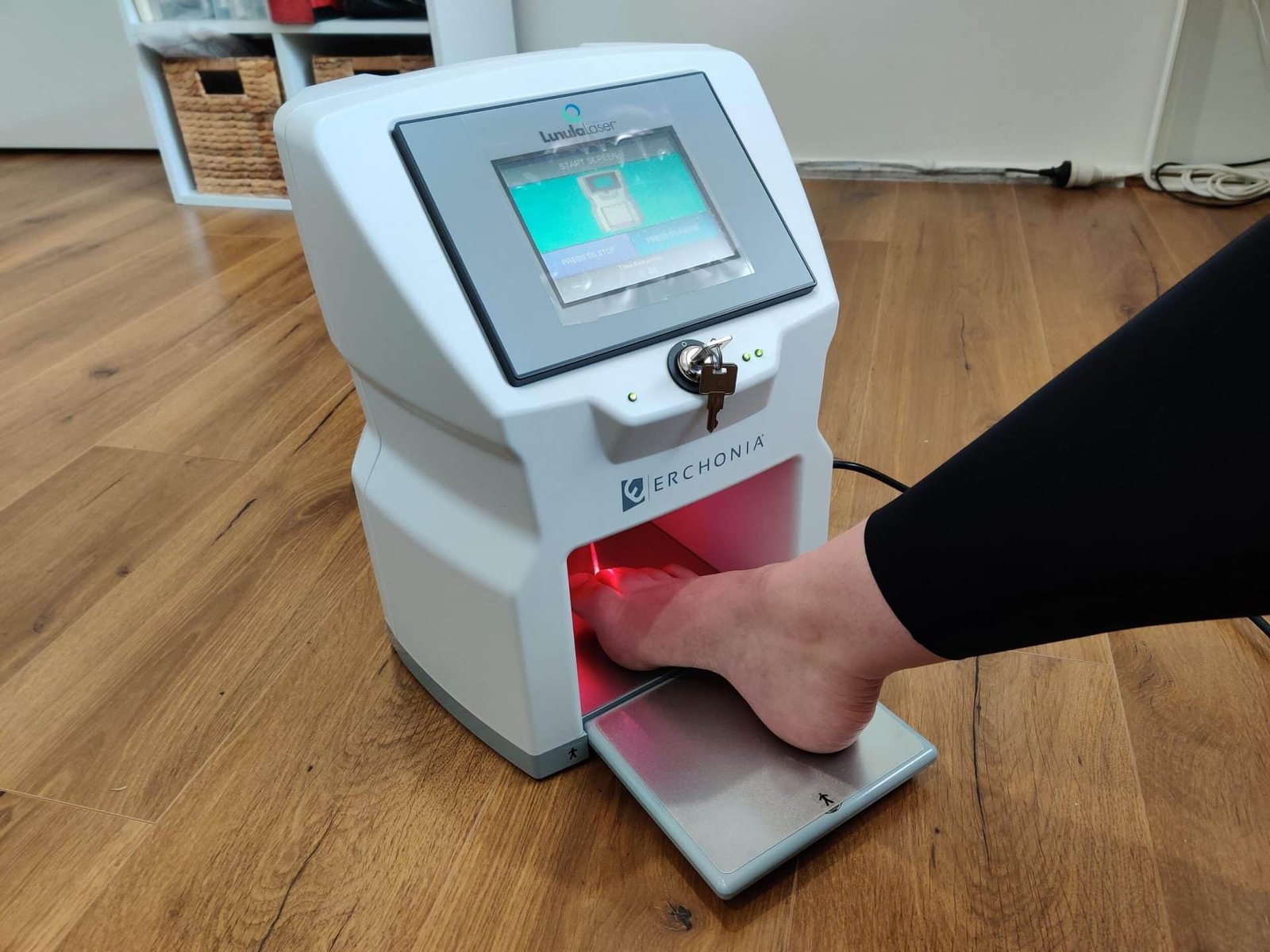
If you’ve been hiding your feet because of thickened, discoloured toenails — or given up on treatments that take months without results — there’s a better option. The Lunula Cold Laser at Peak Performance Institute offers a safe, painless, and evidence-backed approach to clearing fungal nail infections in as few as four weekly sessions.
Led by our senior podiatrist Aaron Gregory, PPI’s Lunula laser service is one of the few in Perth’s inner-city area combining cold laser technology with comprehensive podiatric care — so you’re not just treating the fungus, you’re preventing it from coming back.
What Is the Lunula Cold Laser?
The Lunula Laser, manufactured by Erchonia, is a low-level laser therapy (LLLT) device specifically designed to treat onychomycosis — the medical term for fungal nail infection. Unlike traditional “hot” lasers that use heat to destroy fungal spores (often causing discomfort), the Lunula is a cold laser. It combines two specific wavelengths of light — 405 nanometres (violet) and 635 nm (red) — to stimulate your body’s own immune response against the fungus.
The science is compelling. The 405 nm wavelength targets an enzyme called NADPH oxidase in the fungal spores, increasing the production of reactive oxygen species (ROS) that make the spores vulnerable to your immune system. Simultaneously, the 635 nm wavelength stimulates cytochrome C oxidase in your own cells, boosting ATP production and nitric oxide release — which improves circulation, nutrient delivery, and the infiltration of immune cells into the nail bed. The combined effect enhances your body’s ability to clear the infection while supporting healthy new nail growth.

Why Choose Cold Laser Over Other Treatments?
Fungal nail treatment options exist on a spectrum from “slow and frustrating” to “effective but problematic.” Here’s how Lunula compares:
| Option | Pros | Cons |
|---|---|---|
| Ignore it | No effort | Infection spreads to other nails, other foot, and skin. Risk of secondary bacterial infection. |
| Topical lacquers | Over-the-counter | Months to years of daily application. Penetration through the nail plate is poor — cure rates below 20% in most studies. |
| Oral antifungals | Higher efficacy | Requires liver function monitoring. Drug interactions. Not suitable for everyone. Recurrence rates of 20–30%. |
| Hot laser | Faster than topicals | Heating sensation — uncomfortable for some. May not stimulate the same immune cascade as dual-wavelength cold laser. |
| Nail surgery | Permanent removal | Invasive. Recovery time. Cosmetic outcome varies. |
| Lunula Cold Laser | Painless, no downtime, stimulates natural immune clearance, works on hands and feet | Requires multiple sessions. Best combined with prevention strategies. |
The key advantage of Lunula is its dual mechanism: it’s not just killing fungus, it’s activating your body’s own defences. Studies on low-level laser therapy for onychomycosis have demonstrated mycological cure rates significantly exceeding topical treatments, with minimal to no adverse effects (Kozarev & Vizintin, 2010).
What to Expect: The PPI Treatment Process
- Initial consultation (30 min) — Your podiatrist assesses the extent of the infection, reviews your medical history, and discusses previous treatments you’ve tried. Baseline photographs are taken for progress tracking.
- Nail preparation — If the nail is excessively thickened, a professional nail burr is used to reduce thickness. This improves laser penetration and effectiveness — and it’s completely painless.
- Cold laser treatment (12 minutes per foot) — You sit comfortably while your foot rests inside the Lunula device. The dual-wavelength light bathes the nail bed. Most patients feel nothing at all — some report a mild tingling sensation.
- Shoe sterilisation — While you’re being treated, we sterilise up to three pairs of your shoes using ultraviolet light that kills 99% of fungal spores. This is critical — shoes are a major reservoir for reinfection.
- Weekly sessions × 4 — The standard protocol is one 12-minute session per foot, once weekly for four weeks. This matches the fungal growth cycle and allows cumulative immune stimulation.
- Prevention education — We provide guidance on antifungal laundry rinses for socks, shoe rotation, and environmental hygiene to break the reinfection cycle. You can also purchase a home UV shoe steriliser from the clinic.
Key Benefits of Lunula at PPI
- Completely painless — no heat, no needles, no recovery time. Walk in, walk out.
- No side effects — unlike oral medications, there’s no impact on your liver and no drug interactions.
- Works on hands and feet — fingernail fungus responds particularly well due to faster nail growth.
- Stimulates healthy nail growth — the 635 nm wavelength specifically supports tissue repair and circulation.
- Safe for everyone — suitable during pregnancy, for diabetics, and for elderly patients who can’t take oral antifungals.
- Podiatrist-led — your treatment is conducted by a qualified podiatrist who can address contributing factors like nail trauma, footwear, and biomechanics.
How Long Until You See Results?
This is the most common question — and it requires some patience. The laser clears the fungal infection in the nail bed, but you won’t see the clear nail immediately. Toenails grow at roughly 1.5 mm per month. A big toenail takes 9–12 months to fully replace itself. What you should expect:
- Week 4 (end of treatment): The infection in the nail bed and matrix is addressed. No visible change to the existing nail yet — but the new nail growing from the base should be clear.
- 3 months: A few millimetres of clear nail visible at the base. This is your first visual confirmation the treatment worked.
- 6 months: Approximately half the nail should be clear.
- 9–12 months: Full clearance of the toenail, provided reinfection has been prevented.
At PPI, we take progress photos at your initial visit, halfway through growth, and at the final review — so you can see the transformation objectively.
Who Is Suitable for Lunula?
Most people with fungal nail infections are candidates, with a few exceptions. Lunula is not suitable if more than 50% of the nail is affected by fungus, if the nail has detached from the nail bed (onycholysis), or if there is nail bruising or suspected malignancy. Your podiatrist will assess this at your consultation.
The ideal candidate is someone with mild-to-moderate onychomycosis affecting the distal portion of the nail, who is motivated to follow through with the full 4-week protocol and prevention strategies. It’s also an excellent option for patients who can’t take oral antifungals due to liver concerns or medication interactions.
Why Choose PPI for Your Lunula Treatment?
You’re not getting a laser session and a wave goodbye. At Peak Performance Institute, your Lunula treatment is embedded in a podiatry practice that can address everything around the fungal infection — nail care, footwear advice, biomechanical assessment if your gait is contributing to nail trauma, and access to physiotherapy or exercise physiology if related foot or ankle issues are present.
The clinic is located at 144 Cambridge Street, West Leederville — easily accessible from Subiaco, Wembley, Leederville, Highgate, and Perth’s western suburbs. We treat patients from across the Perth metro area.
Ready to stop hiding your feet? Book your Lunula consultation today — call (08) 9381 1265 or book online at ppiperth.com.au.
References
- Kozarev, J., & Vizintin, Z. (2010). Novel laser therapy in treatment of onychomycosis. Journal of the Laser and Health Academy, 2010(1), 1-6.
- Erchonia Corporation. (n.d.). Lunula Laser — 510(k) clearance K160509. U.S. Food and Drug Administration.
- Zang, K., Sullivan, R., & Shanks, S. (2017). A retrospective study of non-thermal laser therapy for the treatment of toenail onychomycosis. Journal of Clinical and Aesthetic Dermatology, 10(5), 26-30.

