
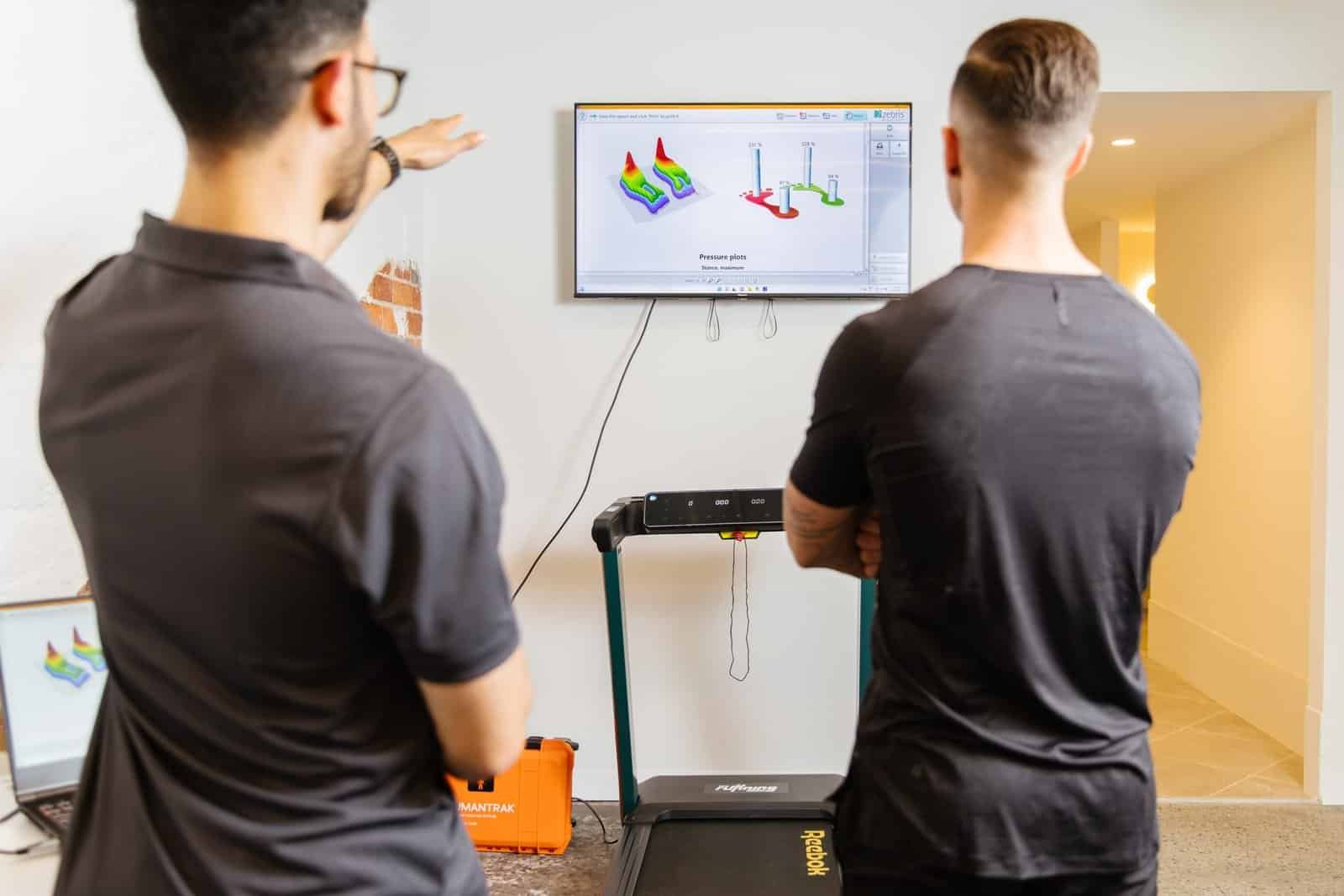
Have you ever wondered why you keep getting the same running injury, or why your performance has plateaued despite putting in the kilometres? The answer might be hiding in your gait — and it’s visible in milliseconds on a Zebris treadmill.
At Peak Performance Institute in West Leederville, our Running Clinic combines the Zebris pressure plate system with high-speed video motion capture to analyse exactly what your body is doing with every single stride. It’s the same technology used in elite sports labs — brought to a multidisciplinary clinic that can actually fix what it finds.
What Is Zebris Gait Analysis?
Zebris is a German-engineered gait analysis system that integrates a pressure sensor matrix — over 7,000 individually calibrated capacitive sensors — directly into a treadmill platform. As you walk or run, it captures pressure distribution, force vectors, foot rotation, and roll-off patterns in real time.
But it doesn’t stop at the feet. Paired with dual high-speed cameras capturing 120 frames per second from behind and the side, the system builds a complete picture of your biomechanics: joint angles at the ankles, knees, and hips, stride symmetry, pelvic movement, and ground contact time. It’s a full-body assessment disguised as a treadmill run.
What Happens During a Running Assessment?
Your session at PPI’s Running Clinic follows a structured, evidence-driven process:
- History and goals — We map your running history, injury timeline, current training load, and goals. Whether you’re targeting a marathon PB or just want to run without the niggles, we tailor the assessment to you.
- Static assessment — Joint range of motion, strength testing, and functional movement screening give us baseline data before you even step onto the treadmill.
- Dynamic gait analysis — You run on the Zebris treadmill at your natural pace. The pressure sensors capture every footfall while video records your movement from multiple angles. We typically capture 20-30 gait cycles at steady state, plus footage at varied paces.
- Analysis and feedback — Your podiatrist or physiotherapist reviews the data with you on-screen, slowing down footage frame by frame to highlight mechanics that may be contributing to injury, inefficiency, or performance limitations.
- Strength and technique prescription — This is where PPI differs from a standard running shop “gait analysis.” We don’t just tell you what’s wrong. We give you targeted exercises to address the root cause — whether that’s gluteal weakness driving hip drop, calf tightness limiting propulsion, or core instability affecting your arm swing.

What the Zebris System Measures
The data these 7,000 sensors generate is extraordinary. Here’s what your practitioner sees:
- Pressure distribution — Heat maps (red = high pressure, blue = low) show exactly where you’re loading through each foot. An asymmetrical pattern might explain that recurring calf strain or metatarsal stress response.
- Centre of pressure (COP) — Tracks how your weight transfers from heel strike through to toe-off. An abnormal COP path can reveal overpronation, supination, or forefoot striking inefficiencies.
- Foot rotation and pronation/supination — Quantified in degrees, not guesswork. Useful for assessing whether orthotic prescription is warranted or whether strengthening alone will correct the issue.
- Stance phase breakdown — Single limb support, loading rate, and push-off force all measured and compared left vs right.
- Gait symmetry — Side-to-side comparisons that highlight compensations — often the first sign of a developing injury before you even feel pain.
- Stride length, cadence, and ground contact time — The metrics that separate efficient runners from those working harder than they need to.
Who Benefits from Running Gait Analysis?
Contrary to a common belief, gait analysis isn’t just for elite athletes. At PPI, we see three clear groups:
1. The injured runner. If you’ve been cycling through plantar fasciopathy, Achilles tendinopathy, shin splints, or runner’s knee, a gait assessment can identify the biomechanical driver — and break the cycle. The research consistently shows that gait retraining combined with strengthening produces better outcomes than rest alone. A 2020 systematic review in the British Journal of Sports Medicine found that gait retraining significantly reduced pain and improved function in runners with patellofemoral pain (Bonacci et al., 2020).
2. The performance-focused runner. If you’re chasing a PB or stepping up to a new distance, small mechanical inefficiencies compound over thousands of strides. Optimising your gait can improve running economy — using less energy at the same pace. Studies have demonstrated that running economy improvements of 2–3% are achievable through targeted gait modifications (Moore, 2016).
3. The new runner. Starting with good habits is far easier than undoing bad ones. A baseline assessment gives you the confidence that your form isn’t setting you up for trouble down the track.
Why a Multidisciplinary Clinic Matters
A gait analysis is only as valuable as what happens next. At PPI, the practitioner conducting your assessment — whether a podiatrist or physiotherapist — can immediately refer you within the same clinic for the support you need:
- Custom orthotics — If the pressure data shows a loading pattern that needs mechanical correction, our podiatrists can design and 3D-scan orthotics on the same day.
- Physiotherapy and strength programming — Your physio designs a targeted program based on the specific weaknesses the assessment revealed.
- Exercise physiology — For runners needing load-management guidance or return-to-run programming.
- Remedial massage — To address the soft tissue compensations that have built up over months of inefficient gait.
You’re not handed a report and sent on your way. You leave with a plan — and a team.
What to Expect: Timeline
| Session | What Happens | Duration |
|---|---|---|
| Initial assessment | History, static screen, Zebris treadmill analysis, video review, initial exercise prescription | 60 minutes |
| 2-week follow-up | Review exercise adherence, refine technique cues, progress loading | 30 minutes |
| 6-week review | Repeat Zebris analysis to quantify changes, adjust program | 45 minutes |
| 12-week reassessment | Full re-analysis including strength retesting, finalise long-term plan | 60 minutes |
The power of the Zebris system is in its ability to track change objectively. At your 6 and 12-week reviews, we overlay your new data onto your baseline — the numbers don’t lie, and neither do the pressure maps.
Ready to Understand Your Stride?
A Zebris gait analysis at PPI’s Running Clinic gives you what no running shop assessment can: medical-grade biomechanical data interpreted by a multidisciplinary allied health team in West Leederville.
Book your Running Clinic assessment today — call (08) 9381 1265 or book online at ppiperth.com.au/running-clinic. Located at 144 Cambridge Street, West Leederville — serving runners from Subiaco, Wembley, Leederville, Highgate, and across Perth’s inner city.
References
- Bonacci, J., Hall, M., Saunders, N., & Vicenzino, B. (2020). Gait retraining versus foot orthoses for patellofemoral pain: a pilot randomised clinical trial. British Journal of Sports Medicine, 54(4), 206-212.
- Moore, I. S. (2016). Is there an economical running technique? A review of modifiable biomechanical factors affecting running economy. Sports Medicine, 46(6), 793-807.
- Zebris Medical GmbH. (n.d.). Dynamic gait analysis on the treadmill — FDM-T system specifications. zebris.de.

