If you’ve ever stepped out of bed in the morning and felt like you’ve been stabbed in the heel, you’re not alone. Plantar heel pain is one of the most common foot complaints we see at Peak Performance Institute in West Leederville. And here’s the thing — despite what you might have heard, it’s usually not an “itis” (inflammation). It’s more like a worn-out piece of rubber that needs the right kind of loading to heal. This guide walks you through what’s actually going on, how we diagnose it using state-of-the-art technology like Zebris gait analysis, and what evidence-based treatments actually work.
First Things First: It’s Not Really “Fasciitis”
You’ve probably heard the term plantar fasciitis. It’s the name that’s been around forever. But here’s the problem — it’s misleading. The “itis” suffix suggests inflammation, yet when researchers have biopsied the tissue of people with chronic heel pain, they consistently find a lack of inflammatory cells. What they actually see is degeneration — collagen breakdown, micro-tears, and disorganised tissue structure [1].
That’s why you’ll increasingly hear health professionals use the term plantar fasciopathy or simply plantar heel pain. It’s more accurate. The plantar fascia — a thick band of tissue running along the bottom of your foot — undergoes degenerative changes over time, especially where it attaches to your heel bone (the calcaneus). Think of it less like a hot, inflamed injury and more like a fraying rope that’s been overloaded for too long [2].
This distinction isn’t just academic. It shapes the entire approach to treatment. If it were purely inflammatory, rest and anti-inflammatories would be the answer. But because it’s a degenerative overuse condition, the solution lies in loading the tissue appropriately — strengthening it rather than babying it.
What Else Could It Be? The Differential Diagnosis
Not every heel pain is plantar fasciopathy. At PPI, we take the time to rule out other possibilities before jumping into treatment. Some conditions that can mimic plantar heel pain include:
- Fat pad atrophy — thinning of the natural cushioning pad under your heel, common in older adults
- Calcaneal stress fracture — a hairline fracture of the heel bone, often from a sudden increase in activity
- Tarsal tunnel syndrome — nerve entrapment that can cause burning or tingling along the inside of the ankle and arch
- Baxter’s nerve entrapment — compression of a small nerve branch that supplies the abductor digiti minimi muscle
- Achilles tendinopathy — pain referring down from the back of the heel
- Systemic inflammatory conditions — such as ankylosing spondylitis or reactive arthritis, which can present with bilateral heel pain
Getting the right diagnosis is critical — and it’s where our multidisciplinary team really shines.
How We Diagnose Plantar Heel Pain at PPI
Most of the time, a thorough clinical history and physical examination are enough. But when things are unclear, or when a patient isn’t responding to initial treatment, we have a significant diagnostic advantage: Zebris gait analysis.
The Zebris FDM system is a high-resolution pressure measurement platform that captures exactly how your foot hits the ground, rolls through your stride, and pushes off. Thousands of capacitive sensors map your pressure patterns in real time — while you’re walking or running. This gives us objective data about your foot mechanics, not just educated guesses [3].
Are you overpronating? Loading heavily through one part of your heel? Is your big toe doing its job during push-off? The Zebris platform answers these questions with precision. At PPI, we’re proud to be one of the few clinics in the West Leederville area offering this technology to our patients.
We can also use ultrasound imaging to assess the thickness and quality of the plantar fascia itself — looking for signs of degeneration, thickening, or partial tearing.
Treatment That Actually Works: The Evidence
1. The Rathleff Protocol (High-Load Strength Training)
This is arguably the most important advancement in plantar heel pain treatment in the last decade. Published in 2014 by Michael Rathleff and colleagues, this randomised controlled trial compared high-load strength training to a standard plantar fascia stretching protocol. The results were striking — the strength training group showed significantly greater improvement at three months, and those gains were maintained at 12-month follow-up [4].
The protocol involves progressive, heavy heel-raise exercises performed every second day — slow, controlled, and with a towel under the toes to engage the windlass mechanism. It’s not glamorous, but it works because it directly addresses the underlying problem: the plantar fascia’s reduced capacity to handle load.
At PPI, our podiatrists and physiotherapists integrate the Rathleff protocol into individualised rehabilitation programs, progressing the load as your tissue tolerance improves.
2. Orthotics and Footwear Advice
Not all orthotics are created equal. Off-the-shelf arch supports can help in some cases, but a custom approach informed by your Zebris gait analysis is far more effective. We assess your foot type, arch height, and loading patterns to determine whether you’d benefit from a temporary off-the-shelf orthotic or a more targeted custom device. Often, the right footwear advice alone — avoiding flat, unsupportive shoes — can make a significant difference.
3. Shockwave Therapy (ESWT)
Extracorporeal shockwave therapy has strong evidence for chronic plantar fasciopathy. A 2024 systematic review and meta-analysis concluded that ESWT is an effective and well-tolerated treatment, particularly for people who haven’t responded to conservative measures [5]. The therapy delivers acoustic waves to the affected area, stimulating blood flow, promoting tissue healing, and breaking down calcific deposits. At PPI, we use shockwave as part of a comprehensive treatment plan — not as a standalone fix.
4. Dry Needling
Dry needling targets trigger points and tension in the calf and foot musculature that often accompanies plantar heel pain. Research suggests it can be particularly effective — one randomised trial found dry needling was actually more effective than shockwave at eight weeks for pain and function [6]. At PPI, dry needling is delivered by our skilled practitioners as an adjunct to your main rehabilitation program.
The PPI Difference: A Multidisciplinary Team Under One Roof
One of the biggest frustrations people tell us about is being sent from one practitioner to another — a podiatrist here, a physio there, a massage therapist somewhere else — with no one actually talking to each other.
That’s not how we work.
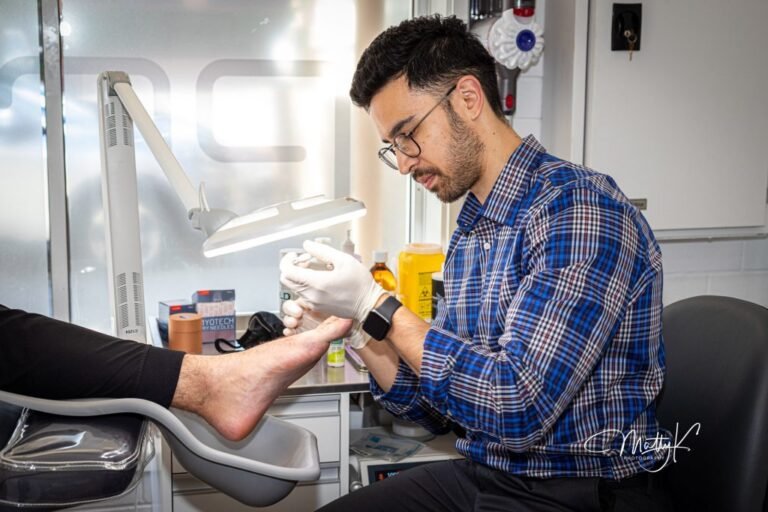
At Peak Performance Institute, our team includes podiatrists, physiotherapists, chiropractors, exercise physiologists, massage therapists, and psychologists — all in one beautiful studio at 144 Cambridge Street, West Leederville. When you come to us with heel pain, you have access to the full picture.
Dr Aaron Gregory, our lead sports podiatrist, has been helping Perth locals overcome foot and lower limb pain since qualifying from UWA in 2013. His performance-focused approach means we’re not just looking to get you out of pain — we’re looking to get you back to running, walking, training, and living without limits.
Your podiatrist might identify a biomechanical issue that could benefit from physiotherapy. A physio might notice you’d respond well to a session of dry needling or some massage work to release tight calves. With us, that’s not a referral to another clinic — it’s a walk down the hallway.
Getting Started: Your Next Step
If you’re dealing with stubborn heel pain that isn’t going away with rest, new runners, or the stretches you found on YouTube, it’s time to get a proper assessment with people who understand the full picture.
At PPI, we’ll sit down with you, listen to your story, assess your movement, and — if appropriate — use our Zebris gait analysis to get the full picture. Then we’ll build a plan that’s tailored to you, your activity levels, and your goals.
Call us today on (08) 9381 1265 to book your appointment. Located at 144 Cambridge Street, West Leederville — just minutes from Subiaco, Wembley, Floreat, and the Perth CBD.