
Strength, Balance and Confidence: Exercise Physiology for Older Adults
At least a third of people over 65 fall each year, and the injury that follows is what most often ends independent living. Here’s what ageing does to muscle, balance, aerobic capacity and power, and what a structured exercise physiology for older adults program does about each of them. It also covers what twelve weeks delivers, and how Medicare covers part of it.
What happens to muscle after 60
Muscle isn’t a fixed asset. Your body builds and breaks it down continuously, and after about 30 the balance tips towards breakdown. Most people lose 3 to 8 per cent of muscle mass each decade, more after 50.
When the loss starts affecting strength or function it has a name: sarcopenia, and roughly one in five Australians aged 60 and over meets the criteria. Size isn’t the whole story, because strength falls faster than muscle mass and power falls faster again.
Not inevitable, though. Consensus guidelines put resistance training first for healthy ageing, and trials in people in their seventies show muscle still adapting to load, provided it’s heavy enough to matter.
Why a fall, not a heart attack, is what ends independence
Falls hospitalise more seniors than any other injury. The Australian Institute of Health and Welfare is blunt about the mechanism: 93 per cent of new hip fractures follow a fall, and nearly half happen at home.
What does the year after a hip fracture actually look like?
Usually surgery, a hospital stay, and a stretch of delirium that leaves people disoriented. Published estimates put one-year mortality at 20 to 30 per cent, and many who were coping at home never recover that independence.
Confidence takes the quieter hit. After one fall, people avoid the places they associate with it: the garden, the stairs, the shops. Activity drops, muscle and balance drop with it, and the next fall needs less provocation. That’s the loop falls prevention programs are built to break.
The four things we train
Four targets, none of them interchangeable.
Strength: two or three sessions a week, two or three sets of eight to twelve repetitions, legs before arms. The last two repetitions of each set should feel genuinely hard.
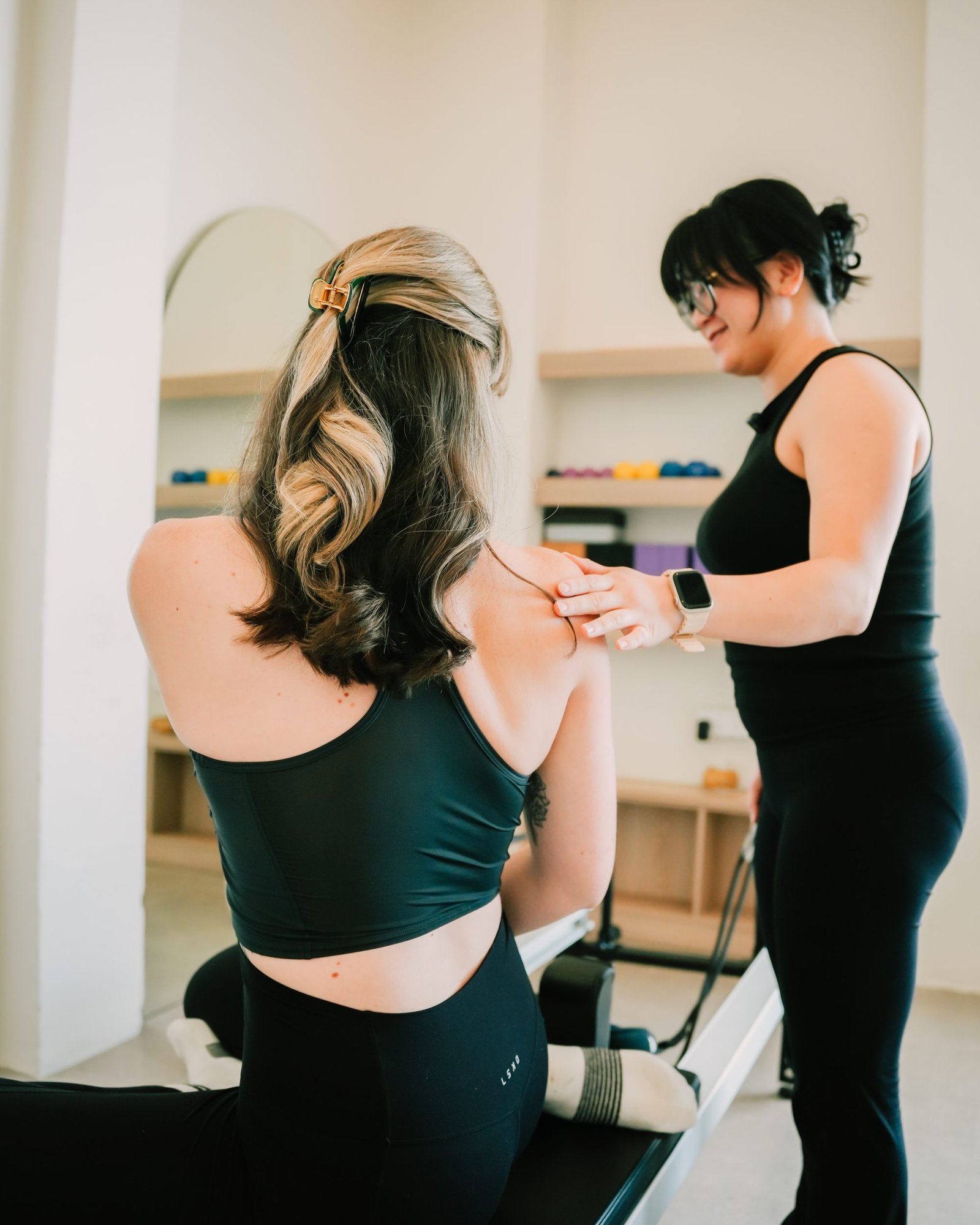
Balance: standing work that shrinks your base of support, which means heel-to-toe stance, single-leg standing and stepping over objects. Balance training has to feel slightly unsettling, so it’s supervised, and our clinical Pilates and physiotherapy sessions are where much of that happens.
Aerobic capacity: 150 to 300 minutes of moderate activity a week, in one block or several. Walk, cycle, swim, row. This pillar looks after your heart, your blood vessels and your brain.
Power is strength multiplied by speed, and it’s the odd one out: you can be strong enough to lift a heavy suitcase and still not fast enough to catch yourself when a foot lands on a wet tile. Fast-twitch fibres are lost early and disproportionately, so power declines faster than raw strength does, and trials comparing them directly found power training beats strength training on the tests linked to fall risk.
One honest caveat. Resistance training alone hasn’t consistently reduced falls, so strength without balance work can make a stronger person who still goes down when pushed off line.
Twelve weeks, realistically
Weeks one to four are mostly neurological. Strength climbs quickly because your nervous system recruits the muscle you already have, so expect the weights to feel lighter before you look different.
Trials of eight to twelve weeks typically record strength and power gains of 30 to 40 per cent, first visible in a five-times sit-to-stand test and in how you take a full flight of stairs. Twelve weeks is enough to move measurements. It isn’t enough to reverse twenty years of decline, and confidence lags a few weeks behind the physical gains.
Muscle size changes more slowly past 75. Detraining is real: stop for three months and much of the gain fades. Maintenance takes far less work than building.
| Week | Focus | Example exercises |
|---|---|---|
| 1-2 | Baseline and technique | Chair sit-to-stand, supported calf raises, 10-minute walk |
| 3-4 | Adding load | Sit-to-stand with dumbbell, leg press, step-ups to a low step |
| 5-6 | Single-leg work | Split squats, single-leg balance with fingertip support, stair walking |
| 7-8 | Introducing speed | Fast sit-to-stands, quick step-ups, medicine ball throws |
| 9-10 | Less support, harder balance | Tandem walking, eyes-closed standing, obstacle stepping |
| 11-12 | Retest and progress | Repeat grip strength, five-times sit-to-stand and six-minute walk |
Modifying around arthritis, osteoporosis and heart conditions
The goals don’t change. The loading, the range and the monitoring do.
Arthritis: load and range are the levers, so knee and hip osteoarthritis usually means shorter ranges, less time held in deep flexion, and slower jumps in weight. Warm-water work helps when land-based loading flares a joint, and the first fortnight is the hard part.
Osteoporosis: the aim is loading bone without loading the spine into a poor position. Repeated spinal flexion, sit-ups and heavy twisting under load get modified, and vertebral fractures rule out high-impact jumping. Balance work matters more than usual, because the fracture is what happens after the fall.
Heart conditions: medical clearance and monitoring matter most here. We work from your cardiologist’s guidance on intensity and avoid breath-holding during heavy lifts. Chest tightness or dizziness stops the session.
Getting the referral that pays for part of it
Exercise physiology sits inside Medicare, but only through a care plan. Ask your GP for a Chronic Condition Management plan; if your condition has lasted, or is likely to last, six months or more, you’ll usually qualify.
That gets you up to five Medicare-subsidised allied health sessions a year, shared across every provider on your plan. They reset on 1 January, not with the financial year.
Be clear-eyed about the limit. Five sessions is a decent start, not a substitute for a year of training; most people use them to get assessed and learn the program, then continue privately. DVA and aged care packages are other routes.
Exercise physiology for older adults at Peak Performance Institute
Our exercise physiologist, Carlos Bervenotti, works alongside the podiatry, physiotherapy, chiropractic and Pilates teams at 144 Cambridge Street, West Leederville, so a falls risk, a sore knee and an old ankle injury get looked at in the same building. Most older adults start with grip strength, a five-times sit-to-stand and a balance screen. Book an exercise physiology appointment or call (08) 9381 1265.


