
The Best Types of Exercise to Increase Bone Density
Osteoporosis affects 1 in 2 women and 1 in 3 men over the age of 50 in Australia, and the lifetime risk of an osteoporotic fracture is greater than the risk of heart attack, stroke, or breast cancer combined. Yet bone is living tissue — it responds to mechanical load just like muscle does. The right exercise prescription can not only slow bone loss but, in many cases, increase bone mineral density (BMD).
This article unpacks the evidence behind exercise for bone health, tailored to different patient profiles: from the young athlete building peak bone mass to the older adult managing established osteoporosis.
How Bone Responds to Exercise
Bone adapts to the loads placed upon it — a principle known as Wolff’s Law. When bone experiences mechanical strain beyond its usual threshold, osteocytes signal osteoblasts to lay down new bone tissue. The key stimulus is not just load magnitude, but also rate (how quickly the load is applied), direction (multi-directional loading is best), and frequency (regular exposure matters).
This is why walking, while excellent for cardiovascular health, is a relatively weak stimulus for bone building — the ground reaction forces are only 1–1.5 times body weight, below the threshold needed to drive meaningful adaptation in most individuals.
What the Evidence Says
The 2024 RACGP and Healthy Bones Australia guideline recommends that exercise for bone health include three components:
- Weight-bearing impact exercises — at least 50 moderate impacts most days (jumping, skipping, heel drops)
- Resistance training — moderate to high loads (8–12 RM) in a variety of movement directions
- Balance training — challenging exercises to prevent falls and the fractures they cause
The landmark LIFTMOR trial (2018) demonstrated that high-intensity resistance and impact training (HiRIT) — including deadlifts, squats, overhead presses, and jumping chin-ups — was not only safe in postmenopausal women with osteoporosis, but produced significant increases in lumbar spine and femoral neck BMD, with zero vertebral fractures. These findings have been replicated in multiple subsequent RCTs and meta-analyses.
Exercise by Patient Profile
1. Children and Adolescents — Building Peak Bone Mass
This is the most critical window for bone health. Up to 90% of peak bone mass is attained by age 18. The osteogenic potential of exercise is highest during puberty, making childhood and adolescence the best opportunity to build a strong skeletal foundation for life.
Best exercises:
– High-impact weight-bearing sports: basketball, netball, volleyball, gymnastics, football
– Plyometric training: jumping, hopping, skipping
– Multi-directional activities that load bone from different angles
– Aim for at least 60 minutes of moderate-to-vigorous activity daily, including 3+ sessions of impact exercise per week
Key message for parents and coaches: A child who plays a variety of sports during their growing years has a significant skeletal advantage that persists into adulthood. This is not about elite performance — it is about building bone capital that pays dividends for decades.
2. Pre-Menopausal Women and Younger Men — Maintenance and Optimisation
Once peak bone mass is achieved (typically by the late 20s), the goal shifts to maintaining BMD through the reproductive years. This is also a window where exercise can continue to modestly improve BMD in those who have not yet reached their full genetic potential.
Best exercises:
– Circuit-style resistance training (squats, lunges, deadlifts, overhead press) 3×/week
– Running or jogging — ground reaction forces of 2–3× body weight provide meaningful stimulus
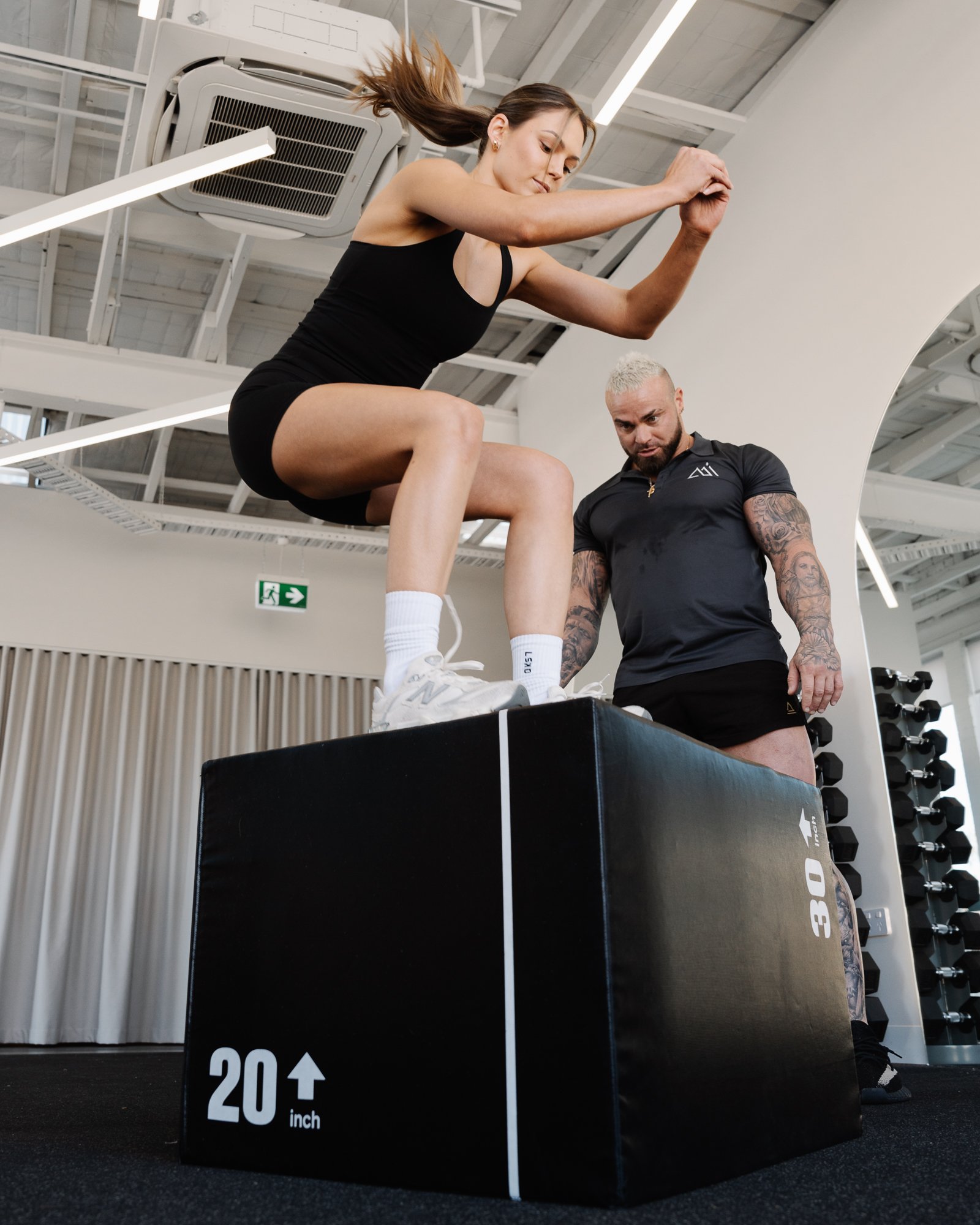
– Jumping rope, box jumps, and plyometric drills 2–3×/week
– Team sports that involve sprinting, cutting, and jumping
Key message: This demographic can tolerate high-impact loading safely. The emphasis should be on progressive overload — gradually increasing load, volume, or impact intensity — to continually challenge the bone adaptation response.
3. Postmenopausal Women — The Highest-Risk Group
Oestrogen deficiency accelerates bone resorption. Women can lose up to 20% of their BMD in the 5–7 years following menopause. This is where exercise becomes both most critical and most nuanced.
Best exercises (with safety considerations):
– HiRIT protocol: deadlifts, squats, overhead presses at 80–85% of 1RM, performed 2×/week under supervision
– Impact training: heel drops, stamping, jumping (if safe for spine — requires screening first)
– Weight-bearing moderate-impact: brisk walking with a weighted vest, stair climbing, dancing
– Balance training: single-leg stands, tandem walking, tai chi — 2–3×/week
Safer alternatives if osteoporosis is established:
– Whole-body vibration platforms
– Resistance bands and bodyweight exercises with careful progression
– Pilates (avoiding spinal flexion — curling forward under load is a fracture risk factor)
– Hydrotherapy and water-based resistance training
Critical to avoid:
– High-velocity spinal flexion (crunch-style sit-ups, toe touches)
– Twisting movements under load (golf swing, Russian twists) without proper bracing
– Exercises that increase fall risk
– Any loading that causes sharp bone pain
Key evidence: A 2025 network meta-analysis of randomised controlled trials found that combined resistance and impact training (CT) and multi-modal balance training (MBT) were the most effective interventions for improving femoral neck and lumbar spine BMD in postmenopausal women. The combination of exercise and nutritional intervention (adequate calcium and vitamin D) produced greater effects than exercise alone.
4. Men Over 50 — The Overlooked Population
While osteoporosis is often thought of as a women’s health issue, 1 in 3 men over 50 will sustain an osteoporotic fracture. Men also have higher mortality rates following hip fractures than women. Yet men are significantly under-screened and under-treated.
Best exercises:
– Heavy resistance training: compound lifts 3×/week at 70–85% 1RM
– Impact activities: running, jumping, stair climbing
– Rucking — walking with a weighted backpack (progress from 10 kg up)
– Balance and mobility work as part of warm-up and cool-down
Key message: Male bone loss is often secondary to other factors — low testosterone, glucocorticoid use, alcohol intake, or smoking. Exercise prescription should be paired with addressing these underlying contributors.
5. Older Adults with Established Osteoporosis or Frailty
For this group, the primary goal of exercise shifts from building bone to preventing falls and fractures. The RACGP guidelines are clear: individual exercise prescription must account for existing bone health status, co-morbidities, and functional or clinical risk factors for falls and fracture.
Best exercises:
– Challenging balance training: stepping in multiple directions, walking on uneven surfaces, standing on one leg while performing upper-body tasks
– Functional strength: sit-to-stand, step-ups, calf raises, hip abduction — all with good alignment
– Weight-bearing impact (if safe): moderate heel drops, gentle stamping, marching with arm swing — progressing from seated to standing
– Spine-sparing core work: supported back extensions, bird-dog, dead bug — all avoiding spinal flexion
Key evidence from the RACGP: Exercise that combines strength, balance, and functional training can reduce fall risk by up to 40% in community-dwelling older adults. This alone has enormous fracture-prevention value — more than 90% of hip fractures result from a fall.
Which Exercise Modality Works Best — the Hierarchy
Based on the current evidence base, here is the hierarchy of exercise effectiveness for bone density:
| Tier | Modality | BMD Effect | Best For |
|---|---|---|---|
| 1 | High-Intensity Resistance + Impact Training (HiRIT) | +++ (L3–5% increase) | Postmenopausal women, men ≥50 (with screening) |
| 2 | Multi-modal resistance + impact | ++ (1–3% increase or maintenance) | Pre-menopausal women, younger adults, general population |
| 3 | High-impact weight-bearing (jumping, plyometrics) | ++ (site-specific) | Children, adolescents, low-risk adults |
| 4 | Moderate weight-bearing (brisk walking with vest, stairs) | + (modest) | Older adults, frail individuals, those who cannot tolerate higher impact |
| 5 | Low-impact (swimming, cycling, walking) | 0 to minimal | Cardiovascular fitness ONLY — not a bone-loading stimulus |
Exercise Physiology at PPI Perth
Not everyone knows where to start, and not everyone can safely jump into a HiRIT protocol without screening. This is where exercise physiology comes in.
At PPI Perth, our exercise physiologists assess your individual risk profile — including bone density history, fracture risk (FRAX score), current medications, fall risk, and functional capacity — before designing a targeted program.
For those with established osteoporosis or osteopenia, we start with a foundation of safe movement patterns, core stability, and balance. From there, we progressively introduce bone-loading stimulus as tolerated, with careful attention to technique and load progression.
For younger, lower-risk individuals, we focus on building robust movement patterns across a range of sports and activities — not only building bone but also developing the motor control, strength, and confidence that keeps people active for life.
Practical Tips Across All Populations
- Variety matters. Bone adapts rapidly to a specific stimulus. Change exercises, angles, loads, and impact patterns every 4–6 weeks to keep the osteogenic response active.
- Progressive overload still applies. Just like muscle, bone responds to increasing demands. Gradually increase weight, impact height, or training volume.
- Nutrition is the foundation. Adequate calcium (1000–1300 mg/day) and vitamin D (at least 800 IU/day) are prerequisites for bone adaptation. Exercise cannot build bone on an empty scaffold.
- Screen first. Anyone over 50 with a history of fragility fracture, early menopause, or prolonged steroid use should have a DXA scan before starting a high-impact program.
- Work with a professional. The evidence is clear that supervised exercise produces better BMD outcomes and fewer adverse events than unsupervised programs in at-risk populations.
Take-Home Message
The right exercise can build bone at any age. The window of greatest opportunity is childhood and adolescence, where high-impact sport participation builds lifelong skeletal capital. For adults — particularly postmenopausal women and older men — targeted resistance and impact training can slow, halt, or even reverse bone loss. And for those with established osteoporosis, a well-designed program combining balance, strength, and safe impact training dramatically reduces the fracture risk that matters most.
Bone health is a lifelong project. Every loading cycle, every jump, every squat — it all counts.
If you would like guidance on safe and effective exercise for bone health, speak to one of our exercise physiologists at PPI Perth. We are located at 1/262 Cambridge Street, West Leederville — accessible from all over Perth.

