If you’ve ever felt a sharp, burning, or aching sensation in the ball of your foot — especially when walking, running, or even just standing — you’re not alone. Forefoot pain is one of the most common complaints podiatrists see, and it can stem from a surprising range of causes. The good news? Most cases respond really well to the right treatment. At Peak Performance Institute in West Leederville, Dr Aaron Gregory and our team take a thorough, movement-based approach to not just relieve the pain, but figure out why it started in the first place.
What Exactly Is Forefoot Pain?
Forefoot pain refers to any discomfort in the front part of the foot — that’s the area before the arch, including the ball of the foot and the toes. Medically, it’s often called metatarsalgia, which sounds fancy but simply means pain around the metatarsal bones. It can show up as a dull ache, a sharp stab, a burning sensation, or even numbness, depending on what’s driving it.
Because the forefoot bears a huge amount of your body weight with every step (especially when you push off to walk or run), even small problems in this area can have a big impact on how you move and feel every day.
Common Causes of Forefoot Pain
Forefoot pain isn’t one-size-fits-all. Here are some of the most common culprits we see at our West Leederville clinic:
Morton’s Neuroma
This is a thickening of the nerve tissue between the toes, most often between the third and fourth toes. It can cause a sharp, burning pain or that classic feeling of “walking on a marble.” Tight shoes and high-impact activities are common triggers. According to the Mayo Clinic, Morton’s neuroma is more common in women, largely due to footwear choices. Early diagnosis makes a big difference — the sooner it’s treated, the less likely it is to cause lasting nerve changes.
Metatarsalgia
Think of metatarsalgia as the umbrella term for pain and inflammation in the ball of the foot. It often develops gradually and is linked to high-impact activities, poor footwear, foot deformities like high arches or flat feet, or simply the natural changes that come with ageing. A 2025 review in Radiologia italiana noted that metatarsalgia is “frequent” and “primarily due to foot static disorders”, highlighting just how common — and treatable — it is with the right biomechanical approach.
Stress Fractures
These tiny cracks in the metatarsal bones often sneak up on people who have recently increased their activity level — runners, hikers, or anyone who’s started a new training program. The pain tends to start as a mild ache during activity and gradually worsens. If you’re noticing pain that gets worse the longer you’re on your feet, it’s worth having it checked out sooner rather than later.
Freiberg’s Disease
This is a less common but important cause of forefoot pain, particularly in younger active people. Freiberg’s disease involves avascular necrosis of the metatarsal head — essentially, the bone temporarily loses its blood supply, leading to collapse and joint pain. It most commonly affects the second metatarsal. The Merck Manual describes treatment as including immobilisation, orthotics, and activity modification — all things we can help with at PPI.
Capsulitis
This is inflammation of the ligaments surrounding the joint at the base of the toes, most commonly the second toe. It can feel a lot like a neuroma, but the pain is more localised to the joint itself. If left untreated, capsulitis can lead to a condition called “predislocation syndrome,” where the toe starts to shift out of alignment.
Sesamoiditis
The sesamoids are two tiny, pea-shaped bones embedded in the tendon beneath the big toe joint. When they become inflamed — often from repetitive pressure like running, dancing, or wearing high heels — the result is a deep, aching pain under the ball of the foot near the big toe. It can be stubborn, but targeted treatment usually gets it under control.
How Podiatry Gets to the Bottom of Forefoot Pain
One of the biggest mistakes people make with forefoot pain is guessing the cause and treating the wrong thing. A podiatrist can tell the difference between a stress fracture and a neuroma — and the treatment for each is completely different.
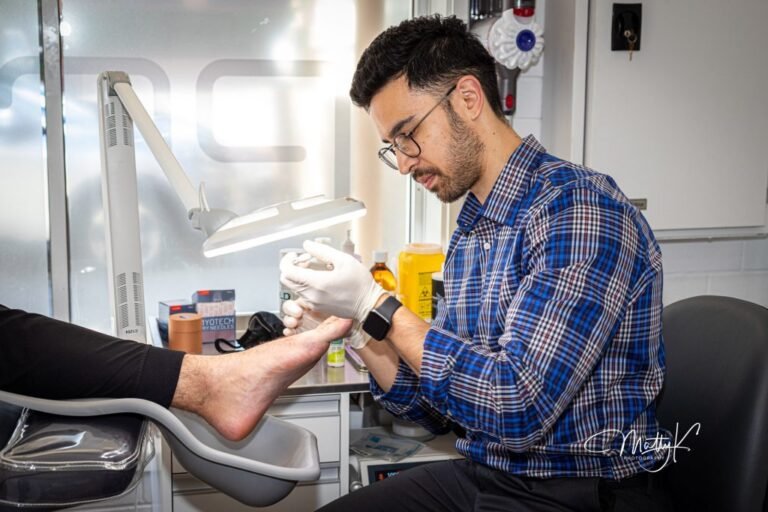
At PPI, we start with a thorough clinical assessment. This includes a detailed history of your symptoms, a physical examination of your foot, and a biomechanical assessment to see how you move — both while walking and standing. We look at your foot posture, joint range of motion, and any gait abnormalities that might be contributing to the problem.
Depending on your presentation, we may also use imaging such as weight-bearing X-rays or ultrasound to get a clearer picture. Ultrasound is particularly useful for diagnosing neuromas and soft tissue issues, while X-rays help us assess bone alignment and rule out stress fractures or Freiberg’s disease.
The key is connecting the dots between what you’re feeling and what’s actually happening inside your foot. That’s where experience and a systematic approach really matter.
Treatment Options for Forefoot Pain
Most forefoot pain can be managed without surgery. At Peak Performance Institute, we tailor every treatment plan to the individual, but there are a few common approaches we use regularly.
Footwear Advice
Sometimes the simplest change is the most powerful. Shoes with a wide toe box, good arch support, and minimal heel elevation can take enormous pressure off the forefoot. We’ll often recommend specific shoe types or modifications, depending on your activity level and foot shape.
Custom Orthotics
This is one of PPI’s specialties. Using advanced gait analysis and 3D scanning technology, we design custom orthotics that redistribute pressure away from painful areas and support your foot’s natural mechanics. For forefoot pain, orthotics can make an almost immediate difference by offloading the metatarsal heads and improving shock absorption.
Activity Modification
This doesn’t mean you have to stop doing what you love — it means finding smarter ways to do it. We help you identify the activities or movements that aggravate your pain and work with you to modify your training load, technique, or recovery routine so you can stay active while you heal.
Padding and Taping
Temporary measures like metatarsal pads, toe spacers, and low-dye taping can provide quick relief by reducing pressure and improving toe alignment. These are often used as a bridge while longer-term solutions take effect.
Injection Therapy
For stubborn cases — particularly neuromas or significant joint inflammation — corticosteroid injections can be a useful tool. They help calm down the inflammation and give you a window of relief to work on the underlying causes through other therapies.
Why Choose Peak Performance Institute?
Forefoot pain can be frustrating, especially when it stops you from doing the things you enjoy. But you don’t have to just put up with it.
Dr Aaron Gregory is a highly experienced sports podiatrist who understands the demands active people face — because he’s an athlete himself. He’s represented Australia at the World Cross Country Championships, worked with elite sporting teams across Perth, and brings a performance-focused mindset to every consult. At PPI, we don’t just treat the symptom; we look at the whole picture — your movement, your goals, your lifestyle — and build a plan that’s as unique as you are.
We’re located at 144 Cambridge Street in West Leederville, making us an easy choice for anyone in Subiaco, Wembley, Floreat, or the Perth CBD looking for expert, honest foot care.
Ready to Get Some Answers?
If forefoot pain has been hanging around for more than a week or two, don’t wait for it to sort itself out. Give us a call at (08) 9381 1265 or book online to make an appointment with Dr Aaron Gregory or one of our podiatry team. We’ll figure out what’s going on and get you moving comfortably again.
Peak Performance Institute — 144 Cambridge Street, West Leederville WA 6007 | (08) 9381 1265 | ppiperth.com.au